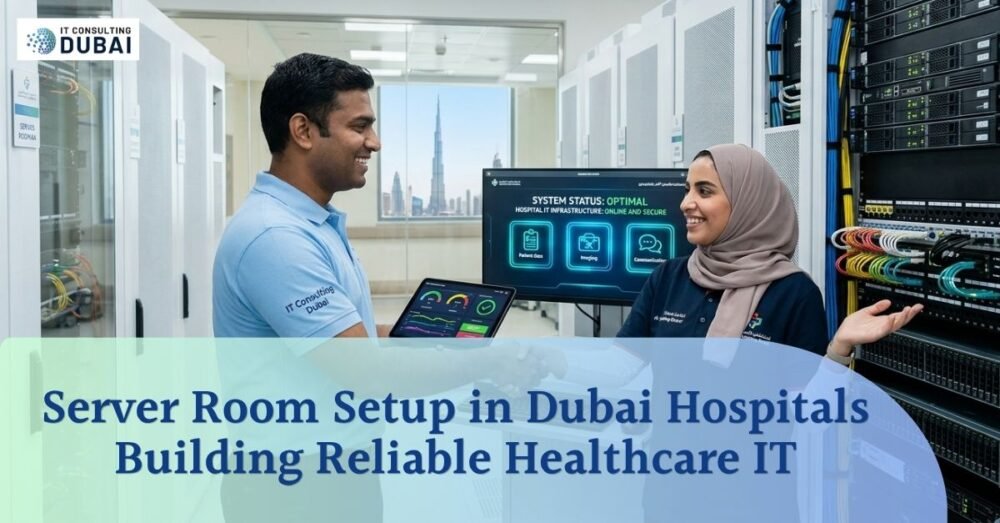
Server Room Setup in Dubai Hospitals Building Reliable Healthcare IT
Inside Dubai’s hospitals, time moves fast, so choices depend on immediate details. Precision matters most when moments pass quickly. Decisions form rapidly because data must arrive without delay. Speed becomes critical where accuracy shapes outcomes constantly. When medical histories appear on screens, when scans deliver results without delay, continuity shapes outcomes behind the scenes.
A single interruption in digital flow can ripple across departments – pharmacy alerts, live vitals tracking, lab coordination – all hinge on stable infrastructure beneath. Hidden within these workflows stands something unobtrusive yet essential: carefully arranged server environments that sustain operations quietly, consistently, day after day.
From strategy to upkeep, IT Consulting Dubai shapes how systems operate within healthcare settings through providing an outstanding Server Room Setup in Dubai. Not limited to basic function, their work strengthens hospitals through safeguards, adaptability, space to grow, and steady performance under pressure.
Server Room Setup Matters for Hospitals in Dubai
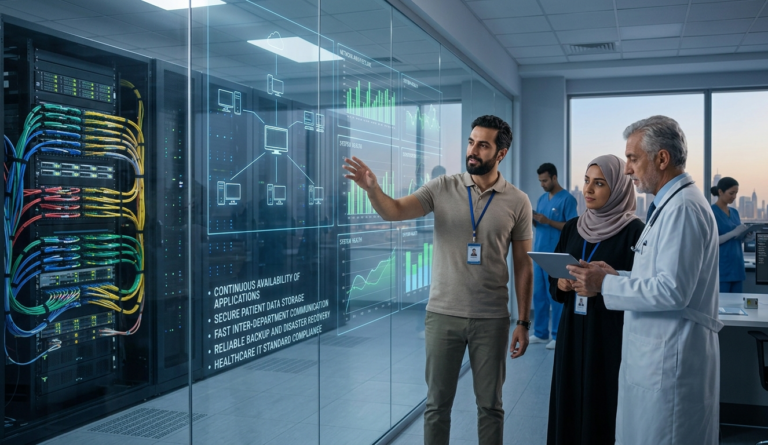
For healthcare providers, interruptions in operations carry heavy consequences. When systems fail, even briefly, medical procedures may stall without warning. Emergency protocols often suffer under such strain. Patient well-being becomes uncertain during these gaps. Unexpected outages reshape care delivery in ways that linger.
A properly engineered server room ensures:
- • Continuous availability of hospital applications
- • Secure storage of sensitive patient data
- • Fast communication between departments
- • Reliable backup and disaster recovery systems
- • Compliance with healthcare IT standards
With growth seen across Dubai’s medical sector, clinics now place greater focus on digital systems, driven by evolving rules alongside higher demands from those receiving care. Though steady expansion continues, technology upgrades become routine within hospital planning, shaped not only by policy but also public need. As standards shift, facility leaders adjust priorities – modern tools enter workflows where older methods once stood.
Essential Components for a Hospital Server Room
A hospital server room begins not with hardware placement but with thoughtful integration of function and reliability. Instead, it grows from systems ensuring steady operation under strict demands. Beyond equipment layout stands the need for resilience against disruptions.
Through careful planning emerges space ready for future upgrades without redesign. Such environments rely on airflow control rather than simple cooling units. Even power supply follows layered safeguards instead of single solutions. Ultimately stability depends less on machines and more on foresight woven into every component.
- Precision Cooling and Stable Environments
Heat output rises sharply in server environments, notably within medical facilities operating around the clock. When temperature control falls short, equipment malfunctions rise alongside unpredictable performance issues.
A hospital-grade server room typically includes:
- • Precision cooling systems (CRAC/CRAH units)
- • Hot aisle and cold aisle containment design
- • Humidity and temperature monitoring systems
- • Air filtration for dust control
Stability within operational conditions supports consistent function of vital medical tools, including diagnostic imaging platforms alongside urgent care record repositories. When surroundings remain controlled, services like radiology networks plus life-critical data storage continue without disruption. For hospital computing needs, predictable settings mean fewer failures in high-stakes scenarios involving real-time access requirements. Equipment relying on constant power and cooling performs more reliably under steady environmental influence. Unwavering climate control contributes directly to availability of time-sensitive health technologies.
- Power Management and Backup Systems
For hospitals, consistent power supply cannot be compromised. When designing a server room, resilience against sudden blackouts becomes essential to sustain ongoing medical functions.
Key components include:
- • Uninterruptible Power Supply (UPS) systems
- • Diesel or generator backup power
- • Dual power supply units for servers
- • Redundant electrical circuits
When outside electricity stops, these setups keep critical hospital functions running without interruption.
- network infrastructure and structured cabling
Cables arranged without clutter support smooth information flow inside medical centers. When connections lack proper planning, delays appear in reaching vital records, affecting daily operations.
Best practices include:
- • Fiber Optic Cables Enable Fast Data Transfer
- • Labeled cabling diagrams
- • Redundant network pathways to prevent downtime
- • One network handle medical operation, while another manages office tasks
Well-structured systems allow hospitals to maintain rapid, protected information exchange between units like radiology, pharmacy, lab work. When setup is accurate, movement of records stays both quick and shielded. Among key areas, imaging, medicine dispensing, testing rely on steady digital pathways. Smooth operation often follows careful planning in network layout. Without strong architecture, delays may appear alongside risks to confidentiality. Each section depends upon consistent access without exposure. Where design meets need, transfer becomes reliable by default.
- Server Hardware Meets Virtualization
Every day, advanced medical centers depend on high-performance computing units to manage vast streams of live information. Such infrastructure enables tools used for monitoring patient vitals continuously.
From diagnosis platforms that update instantly to digital records adjusting in real time, behind the scenes, processing power ensures seamless coordination across departments, without delay imaging results move directly to specialists’ workstations, even scheduling adjustments respond immediately to changing conditions, performance never pauses when demands increase suddenly, data flows securely between devices without interruption, each operation relies on stable computational strength beneath the surface.
- • Electronic Health Records
- • Laboratory Information Systems
- • Radiology Information Systems
- • Patient monitoring platforms
Running several applications on limited hardware often relies on virtualization, through this method system resources get better utilization without adding servers, efficiency rises because tasks share infrastructure under controlled conditions, cost factors decline when companies operate with reduced equipment needs, maintenance becomes more manageable due to centralized control environments.
- Security and access control systems
Information from hospitals requires strict safeguards due to its private nature, therefore defenses guard it from intrusion or digital attacks. Protection within a server space builds through varied barriers working together yet separately.
These include:
- • Biometric or smart card access control
- • 24/7 CCTV surveillance
- • Fire detection and suppression systems
- • Secure rack enclosures
- • Role-based IT access policies
What many overlooks is how safety shifts beyond locks into code, where barriers guard data instead of doors. Firewalls stand like silent sentinels, while scrambled messages hide meaning in plain sight. Watching without blinking, automated eyes track each shift across networks. Protection evolves when screens replace walls.
IT Consulting Dubai and hospital server room projects
When shaping healthcare IT setups in Dubai, professional guidance becomes necessary. For hospitals, unique preparation matters – safety, rules, long-term function depend on it.
- Infrastructure Check and Strategy
Beginning with hospital needs, IT consultants review specific demands like:
- • How many individuals plus teams?
- • Data storage needs
- • Application workload demands
- • Future expansion expectations
From such analysis emerges a structure shaped by daily medical workflows, built to support evolving institutional aims. One element follows another, each positioned where function meets intent.
- Design That Grows and Adapts Over Time
With change constant in healthcare tech, scalability becomes essential within a properly structured server space, not merely adaptable but built anticipating growth, such capability ensures long-term function without overhaul, as demands shift gradually or suddenly, infrastructure able to respond maintains consistent performance, flexibility embedded early prevents future constraints, one that allows expansion by design fits evolving needs seamlessly.
- • New medical applications
- • Increased patient data volume
- • AI-based diagnostic systems
- • Cloud integration and hybrid IT environments
Stability emerges gradually, shaped by careful input from technology advisors who prevent disruptive changes down the path. When guidance aligns early, systems evolve without sudden replacements becoming necessary.
- High Availability and Disaster Recovery
When systems stop working, patient care may suffer. To prevent interruptions, specialists put plans into place that include:
- • Redundant servers and failover systems
- • Real-time data replication
- • Backup data centers or cloud recovery solutions
- • Automated recovery protocols
Should systems fail, hospitals remain operational through these protocols. Even during disasters, continuity is maintained by design. Through redundancy, function persists without interruption. When technology falters, processes adapt silently. Resilience emerges not from tools but structure. Despite breakdowns, care delivery does not halt. By planning ahead, services endure unforeseen events.
- monitoring maintenance and managed it services
A server space needs constant observation so that operations remain stable while protection stays intact. Providers of technology advice deliver:
- • 24/7 infrastructure monitoring
- • Regular hardware inspections
- • Software updates and patch management
- • Performance optimization
- • Cybersecurity threat detection
This method reduces exposure to problems while maintaining stable performance across time. Still, its strength lies in early intervention before failures occur.
Better Hospital Server Room Design Improves Safety and Efficiency
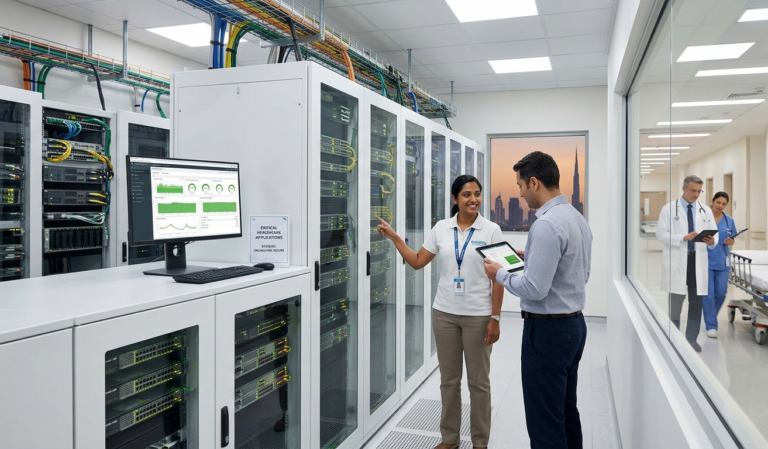
A well-planned server room delivers significant advantages for healthcare institutions in Dubai:
- • Continuous availability of critical systems
- • Faster access to patient records and diagnostics
- • Strong protection of sensitive medical data
- • Fewer System Failures
- • More efficient operations department wide
- • Scalable infrastructure for future technologies
Improved patient care emerges alongside more efficient hospital workflows, operations gain stability as clinical outcomes gradually strengthen, greater reliability in treatment follows naturally when systems function with fewer disruptions, patient safety tends to rise under such structured conditions, streamlined processes often lead to consistent results across departments.
Smart Hospital Server Room Solutions for Dubai Medical Centers
A hospital server room setup forms the core of today’s medical infrastructure. From managing health data to enabling imaging technologies, its structure demands accuracy, consistent performance, safety – each element carefully considered without exception.
Among hospital priorities, stable technology stands clear when supported by expert advice in Dubai’s consulting sector. Instead of generic setups, facilities gain custom frameworks designed for present function alongside growth ahead, through balanced integration of temperature control, backup energy sources, organized wiring layouts, digital resource sharing, and data protection layers, medical centers form durable operations. This foundation allows healthcare delivery to continue without disruption even under pressure.
With every shift in Dubai’s healthcare landscape, reliance on well-structured server rooms grows unavoidable, safeguarding patient care depends on it, though unseen, these systems anchor daily operations, ensuring data flows without delay or risk, when infrastructure falters, treatment timelines stretch; resilience prevents such breaks, behind quiet screens and locked doors, stability takes shape through deliberate design, efficiency emerges not by chance, but through consistent technical oversight from IT Consulting Dubai, medical progress now walks hand-in-hand with digital backbone strength, without solid foundations below the surface, responsiveness above suffers silently.